How to climb the Giralda: a practical 2026 guide
The Giralda climb explained: 35 ramps + 17 stairs, around 70 m vertical, no elevator, what to expect at the top, who should and shouldn't attempt it.
When our editors shortlisted the seven Giralda tours worth booking (see the full picks page and the comparison matrix on our home page), the same handful of questions kept surfacing in reviewer notes: how many ramps are there really, how hard is it for kids and older travellers, can you bring a wheelchair, what does the top actually look like, and is Phase VI restoration in the way? This guide pulls together the verified answers — sourced from the Cabildo of Seville Cathedral, Wikipedia, and dozens of recent visitor reports — and ends with the picks from our home page that map cleanly to specific climber profiles.
The Giralda climb in one paragraph
You enter through the Cathedral interior, follow signs to the base of the tower in the north-east corner near the Capilla Real, and then walk up 35 gently sloping brick ramps that spiral around seven vaulted interior chambers, plus 17 stone steps at the very top to reach the bell-chamber viewing gallery. The ramps were laid down in the Almohad period (1184–1198) wide enough that a muezzin could ride to the top on horseback to call the faithful to prayer — a thousand-year-old accessibility design that still makes this climb materially easier than the stair-only towers in Florence, Rome, or London. The total tower is approximately 95 m tall and the climbable portion is approximately 70 m of vertical gain; the top public balcony sits at the base of the bell chamber, below the Giraldillo weathervane.
How long the climb actually takes
A fit adult in normal walking shoes reaches the top in 10–15 minutes. On a crowded summer afternoon, the same climb stretches to 30–45 minutes, almost entirely because the ramps narrow at the corners and a slow climber ahead bottlenecks everyone behind. The Cathedral’s own guidance is 15–20 minutes up, 10–15 minutes down. Reviewers consistently say their actual time depended on whether they ran into a school group or a cruise excursion on the way up, not on their fitness.
| Conditions | Ascent time | Descent time | Time at the top |
|---|---|---|---|
| Fit adult, off-peak Tuesday in November | 10–12 min | 5–8 min | 15–20 min |
| Fit adult, peak summer Saturday at 1 pm | 25–45 min | 10–15 min | 10–15 min (crowd pressure) |
| Family with kids 8+, mid-season weekday | 20–25 min | 10–12 min | 20–30 min |
| Older traveller pacing themselves with breaks | 25–35 min | 15–20 min | 15–25 min |
There are no rest benches inside the tower — only window niches every few ramps where you can step out of the flow of traffic, catch your breath, and let people pass. Bring a water bottle. In summer the interior holds heat well into the evening because the walls are massive Almohad masonry.
Ramps, stairs, height: the numbers and the footnote
The canonical figure is 35 ramps + 17 final stairs. A substantial minority of secondary sources count 34 ramps; the discrepancy appears to depend on whether the initial entry ramp at base level is included. We use 35 throughout this guide because that is the figure Wikipedia, sevillecathedral.es, and Voyager Seville agree on; if you count one fewer on your own climb, you have not miscounted, you have made a defensible interpretive choice.
The 95 m tower-height figure is the one we prefer over the 104 m figure that floats around tertiary travel sites. The Wikipedia / Wikidata cluster (around 94.69 m to the tip of the Giraldillo) is consistent with the Cathedral Chapter’s own measurements; the 104.5 m number does not appear in any tier-1 source and is most likely a measurement that includes the lightning-rod mast above the weathervane, which is not part of the architectural height.
What you climb is approximately 70 m of vertical gain. The lower section of the tower is solid Almohad masonry not opened to the public, and the top platform sits at the base of the bell chamber rather than at the very top of the building. So when you stand at the highest accessible balcony, you have roughly the same elevation as the top of Big Ben (96 m total height, 334 stair climb to the belfry); when you compare effort, you have done a small fraction of the work because nearly all of the 70 m is ramped, not staired.
How the Giralda compares to other famous European bell-tower climbs
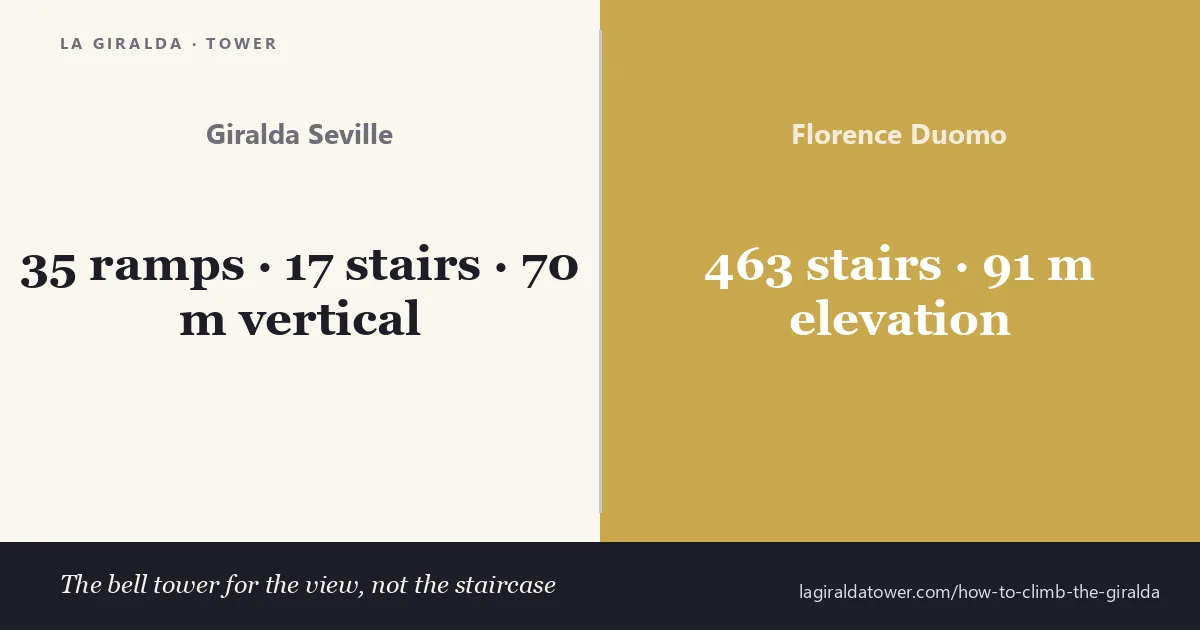
Reviewers ranking the Giralda against towers they have climbed elsewhere keep arriving at the same conclusion: this is the bell tower for people who like the view but not the staircase.
| Tower | Total stairs / ramps | Elevation climbed | Difficulty vs Giralda |
|---|---|---|---|
| La Giralda, Seville | 35 ramps + 17 stairs | around 70 m | benchmark |
| Florence Duomo (Brunelleschi’s dome) | 463 stairs | around 91 m | substantially harder — stair-only, narrow at the top |
| St Peter’s Basilica, Rome | 551 stairs (231 if you take the lift partway) | around 137 m | harder, tighter spiral at the cupola |
| Big Ben, London | 334 stairs | around 96 m total height | similar elevation, stair-only |
The takeaway: if you have ever told yourself you are not the kind of traveller who climbs cathedral towers, the Giralda is the one that is worth a reconsideration. The ramps change the experience qualitatively, not just quantitatively.
Who should and shouldn’t attempt the climb
Reviewers and the Cathedral’s own accessibility pages converge on a clean three-bucket profile:
Comfortable — climb without hesitation. Healthy adults of any age, teenagers, fit kids 8+, runners and walkers in normal cardio shape, and most pregnant travellers in their first and second trimesters. The climb is below the threshold of “exercise” for this group; they will read the height numbers on this page, do it, and remember the view rather than the effort.
Doable with caveats — plan around it. Older travellers managing knees or hips, anyone in late third-trimester pregnancy, people with mild claustrophobia (the ramps narrow at the corners and the seven vaulted chambers feel close), people who tire in hot conditions (summer interiors are hot), and parents carrying small children in front-carriers (manageable but the descent is harder than the ascent because of how the carrier sits). For this group, the right move is to climb early — first thing after Cathedral opening, or in the official off-peak 15:30–17:00 window — and accept that you may take 30–40 minutes on the way up.
Should not attempt — choose a different vantage point. Wheelchair users (the Cathedral’s accessibility page explicitly does not cover the Giralda; seville-tickets.com states “wheelchair users are not allowed to scale it”); travellers with severe knee or hip problems for whom 70 m of any kind of incline is a problem; anyone with active heart conditions or recent surgery without medical clearance; people with severe claustrophobia. If you fall in this group but want the Giralda in your photographs, our golden-hour guide section — La Terraza del EME rooftop bar on Calle Alemanes 27 — gives you a Giralda foreground at street level with no climb at all.
For mixed-mobility groups, our Best for families pick on the home page (Seville Unique Experiences, tour 491665) is the one operator in our dataset whose listing explicitly says the climb is optional and the group can wait at ground level in the Patio de los Naranjos and rejoin afterwards. That is rare in this niche, and it is the right pick when one person in your party falls in the “should not attempt” bucket.
What the top looks like — and the wire-mesh footnote
The top platform is a wrap-around belfry gallery facing all four cardinal directions. The view is the entire historic centre of Seville from above the rooftops: the Real Alcázar gardens directly south through Plaza del Triunfo; Plaza Virgen de los Reyes and the Barrio Santa Cruz to the east; Calle Placentines and the city centre to the north; the Patio de los Naranjos, Avenida de la Constitución, the Guadalquivir and Triana to the west.
Every reviewer mentions the same caveat: protective wire mesh on every opening. The mesh is there to stop visitors from leaning out over the city, and it has been there for decades; it obstructs photo composition but not the view itself. If you are climbing for the photographs and not the experience, plan to lean a phone or a small camera close to the mesh (in the gaps the metalwork creates) rather than expecting an unobstructed wide-angle shot.
The other expectation-management item is the bells. The Giralda holds 24 bells — the largest, Santa María Mayor, weighs about 5 tonnes and stands roughly 2 m tall — and they can ring without warning. At close range, visitors describe them as “absolutely deafening.” If you wear hearing aids, mute them at the top; if you are bringing hearing-sensitive children, plan around the half-hour ringing schedules where you can; otherwise enjoy the surprise, because the sound is unforgettable.
Phase VI restoration — yes, you can still climb in 2026
Phase VI restoration of the Giralda’s Renaissance Crown — the upper belfry containing the bells, below the Giraldillo — began 14 April 2026. The Cabildo of Seville Cathedral has issued a clear public statement: “Cultural visits to the monument will not be interrupted at any time.” Scaffolding is visible on the bell chamber and one of the four faces is closed at any moment to allow the materials crane to operate, but the climb itself stays open.
May 2026 TripAdvisor reviews confirm this: visitors mention the crowds and the parapet wire mesh, not scaffolding blocking the climb. If you are reading reseller-site copy that hedges “may limit access,” that is a tour operator hedging their own liability — not a Cathedral statement. Book confident the climb is in scope through the restoration window, which the Cabildo expects to run roughly 22 months and into late 2027 or early 2028.
The Cathedral dress code applies to the climb
Because you enter the Giralda through the Cathedral interior, the Cathedral dress code applies: covered shoulders and covered knees — no sleeveless tops, see-through clothing, hats indoors, or bare feet. The dress code is enforced at the ticket scanner. In summer, the cleanest workaround is a lightweight scarf or shawl in your bag. Staff will allow shoulders covered any way; you do not need a long-sleeved layer.
Which of our picks includes the climb (and which doesn’t)
Of the 24 tours we compared, 18 include the Giralda climb and 6 do not. The 6 exclusions are mostly evening or specialty tours where the Giralda is closed during the tour’s operating hours; the most notable is tour 1157658, “Cathedral under the Stars,” which explicitly excludes the Giralda — the reason it does not appear among our 7 picks even though “best for evening” was a slot we considered.
Among the 7 picks on our home page that do include the climb:
- Best overall — Alcázar Seville Tour, $68 — the licensed local guide takes you up the ramps end-to-end as part of the three-monument bundle.
- Runner-up — Crown Tours, $63 — same end-to-end climb included; the only difference is operational polish.
- Best skip-the-line — Voyager Seville, $38 — Cathedral + Giralda guided tour, 90 minutes, the shortest among guided picks.
- Best for families — Seville Unique Experiences, $55 — the one operator that makes the climb explicitly optional for groups with mixed mobility.
- Best Alcázar combo — Crown Tours (triple-slot with runner-up + best-premium) — same climb as the runner-up, with the Alcázar logistics + ticket scarcity angle in focus.
- Best premium — Crown Tours 800561 Private Tour variant — same climb as the runner-up; what changes is the dedicated guide and adjustable pace. The 10,337 verified reviews carry across all three booking variants on this SKU, which is why we point here instead of at a thin-data private-only listing.
If you book the best-budget pick (the Cathedral’s own e-ticket sold via GYG at $20), the climb is included in the standard entry, but you will not have a guide reading the architecture for you — bring an audio guide upgrade or this guide on your phone.
Quick climbing checklist
Before you walk into the Cathedral, do five things:
- Check the opening hours and 2026 closure dates — particularly Holy Week, when reduced morning-only hours apply.
- Wear shoes you can climb in for 70 m of incline without thinking about — soles with grip, not loose sandals.
- Cover shoulders and knees for the dress code at the entrance scanner.
- Bring a small water bottle, a phone or camera, and (if you wear hearing aids) something to mute them with at the top.
- Decide before you enter whether anyone in your party will skip the climb — if so, you want our Best for families pick, where the group can wait in the Patio de los Naranjos and rejoin.
Ready to book?
If you have read this far, you are climbing. Our editorial recommendations for which tour fits which climber profile are on our home page picks section; the comparison matrix shows all 24 currently-listed GYG tours side by side; and the FAQ covers the corner cases (pregnant visitors, children under 8, the bell-ringing schedule, free Sunday admission). For the methodology behind why we ranked the picks the way we did, see How we picked.
Ready to Climb the Giralda?
Our top pick for visiting Seville's Cathedral and the Giralda is Alcázar Seville Tour — a 3-monument, skip-the-line guided combo with 12,325 verified reviews at 4.78★, and a meeting point that sits literally between the Cathedral and the Alcázar. From $68 per person.
See our 2026 picks